Inside every fat cell is a solution to the problem that has stalled AI for thirty years.
The dominant story about artificial intelligence in 2026 is a story about scale. Bigger models, longer contexts, more parameters swallowed from the open web. The numbers keep climbing and the benchmarks keep falling, but a different number has started climbing too: the cost of each additional unit of competence. Frontier models still forget what they learned last quarter the moment you fine-tune them on something new. They still buckle when the world shifts under their feet. The architecture is fragile. It was never built to specialize without forgetting. It was built to interpolate.
The interesting question is what a different substrate would look like. Not a different model class within the same family, not a clever trick layered on top of attention, but a genuinely different physics of computation. A clue arrived in late January on bioRxiv, in a paper from scientists at Daice Labs and MIT CSAIL. The paper is titled "Rectifying Stress into Structural Memory Drives Specialization in Cells and Adaptive Computational Systems." On the surface, it is a cell biology paper about how fat-tissue stem cells lock in their identity under metabolic stress. Read more closely, it is one of the most concrete articulations to date of what an alternative computational substrate might be.
Ask a modern AI system to learn something new, and it will, with surprising willingness, forget almost everything it knew before. The phenomenon has a name in the research literature: catastrophic forgetting. You can train a network to recognize cats, then train it on dogs, and watch its cat performance collapse. Engineers have built workarounds, but the underlying problem keeps reappearing in new forms.
Now consider a fat cell. Not a particularly glamorous unit of biology, but one that does something no neural network can. When you skip a meal, the stem cells in your adipose tissue feel the metabolic stress and have to make a decision. Should they specialize into one kind of fat cell, the kind that stores energy, or another, the kind that burns it? Whichever path they choose, they need to commit. They need to lock in their identity strongly enough that the next dietary fluctuation does not erase it, while staying flexible enough to respond to genuinely new conditions. They have been solving this problem, the same plasticity-versus-stability problem that haunts AI labs, for roughly a billion years.
The paper from Daice Labs and MIT CSAIL argues that the way cells solve this problem is not just biologically interesting. It is a recipe. The recipe describes how a continuous physical system can convert disturbance into durable memory, and the authors claim it works just as well in silicon as it does in tissue. They call it asymmetric-drive rectification, and the phrase deserves unpacking, because the idea inside it may turn out to be one of the more consequential of the decade.
Start with electricity. A diode is a component that converts alternating current, the kind that swings back and forth, into direct current, the kind that flows in one direction. The technical word for what it does is rectification. Disorganized energy comes in, organized energy comes out, and the trick is asymmetry: the diode lets current pass one way and blocks it the other way. Nothing in the input is ordered. The order is imposed by the device.
Cells, the new paper argues, are doing something analogous but with information instead of voltage. The disorganized input is metabolic stress, the daily turbulence of nutrients arriving and departing. The organized output is a specialized cell type with stable gene expression and a settled identity. In between sits a biological diode, and the team has spent years figuring out exactly what it looks like.
When nutrients drop, the pH inside the cell starts to oscillate, swinging between slightly more acidic and slightly more basic. Those swings are asymmetric. They do not cancel out. A protein called ATP12A, a proton pump previously studied in cystic fibrosis research but never cast in this role, regulates the rhythm. The pH oscillations propagate inward to the nucleus, where they alter the dynamics of liquid-like compartments that contain different gene sets. When the pH rhythm and the compartment rhythm fall into phase alignment, the system rectifies them. The transient disturbance gets converted into a permanent structural change. Mitochondrial programs commit. Epigenetic marks settle. The cell has specialized. Knock down ATP12A, and the rectification weakens. Boost it, and the specialization becomes more durable. The diode has a knob, and the knob has consequences.
Tuyéras and Agudelo are not standard cell biologists. They are mathematicians by training, and the framework they use to describe what cells are doing comes from a corner of category theory called operads. An operad is a formal description of how parts compose into wholes. It tells you the rules by which smaller pieces, each with their own well-defined interface, can be plugged together into bigger pieces, which can themselves be plugged into still bigger ones. Operads are the natural mathematics of nested hierarchy, and they have been used to describe the syntax of programming languages and the algebra of trees.
In a 2021 preprint, the Daice Labs and MIT CSAIL team proposed that cells should be understood as operadic algebras: hierarchies of compartments where each level computes something, and where the compositions follow formal rules. Mitochondria sit inside cytoplasm sits inside cells sits inside tissues. At each level, energy flows act as the optimizer, pushing the system toward configurations that better dissipate stress. The new paper sharpens this picture, with rectification as the engine.
To prove the framework was not just metaphor, the team built a machine learning system that implements it directly. The system, a descendant of an algorithm they call IntCyt, does not look like a transformer or a convolutional network. It grows. Starting from a single root compartment, it splits into a tree of specialized child compartments, each handling a different slice of the data. The compartments carrying high reconstruction error undergo more reorganization. The ones that handle their inputs well stay stable. Run this on the MNIST digit dataset and the tree carves itself into a hierarchical decomposition, with different leaves taking responsibility for different digit clusters. Run it on the DREAM3 gene expression challenge and it competes with established methods. In both the cells and the algorithm, what the team measures next is the same: local organization gains track dissipation. When more stress is being processed, more structure is being built. When residuals fall, structure consolidates. Two completely different substrates, one made of proteins and lipids, the other made of floating-point numbers, are following the same rule.
To understand why this lands the way it does, it helps to look at the state of modular AI. The dominant approach to modularity in large models right now is called Mixture of Experts, or MoE. Instead of running every input through the entire network, you route each input to a small subset of feed-forward blocks called experts, picked by a learned gating function. It saves computation, but the experts do not really specialize in any deep sense. They are interchangeable, anonymous capacity slots, and the gating function can collapse onto a few favorites if you let it.
Yoshua Bengio has argued, in papers starting with "Inductive Biases for Deep Learning of Higher-Level Cognition," that real modularity has stable, addressable, recombinable parts that emerge through pressure and persist across tasks. Gary Marcus has made the same point louder and longer about compositional symbolic structure, and the recent success of neurosymbolic systems like DeepMind's AlphaGeometry and AlphaProof, which solve olympiad-level mathematics by yoking a neural search engine to a formal logic engine, has given the argument empirical weight in domains where pure scaling stalls.
But neurosymbolic AI, as currently practiced, is an admission of defeat. It bolts a symbolic system onto a neural one because neither can do the other's job. The operadic framework offers a different proposition. An operadic algebra is, by construction, both compositional in the formal symbolic sense and continuous in the dynamical-systems sense. There is no seam to bolt together. The structure is symbolic. The contents are neural. They share a substrate. The plasticity-stability problem looks different through this lens too. Liquid neural networks, the differential-equation models that Ramin Hasani and Daniela Rus's group at MIT CSAIL have developed, give neurons continuously varying time constants so they keep adapting at inference time. JEPA, Yann LeCun's joint-embedding predictive architecture, predicts in abstract representation space rather than pixel space, letting the model concentrate capacity where it helps. Each of these is correct in some local sense, and each leaves the same gap. None tells you which part of the system should specialize, and none gives you a principled way to convert the stress of a distribution shift into durable structural change.
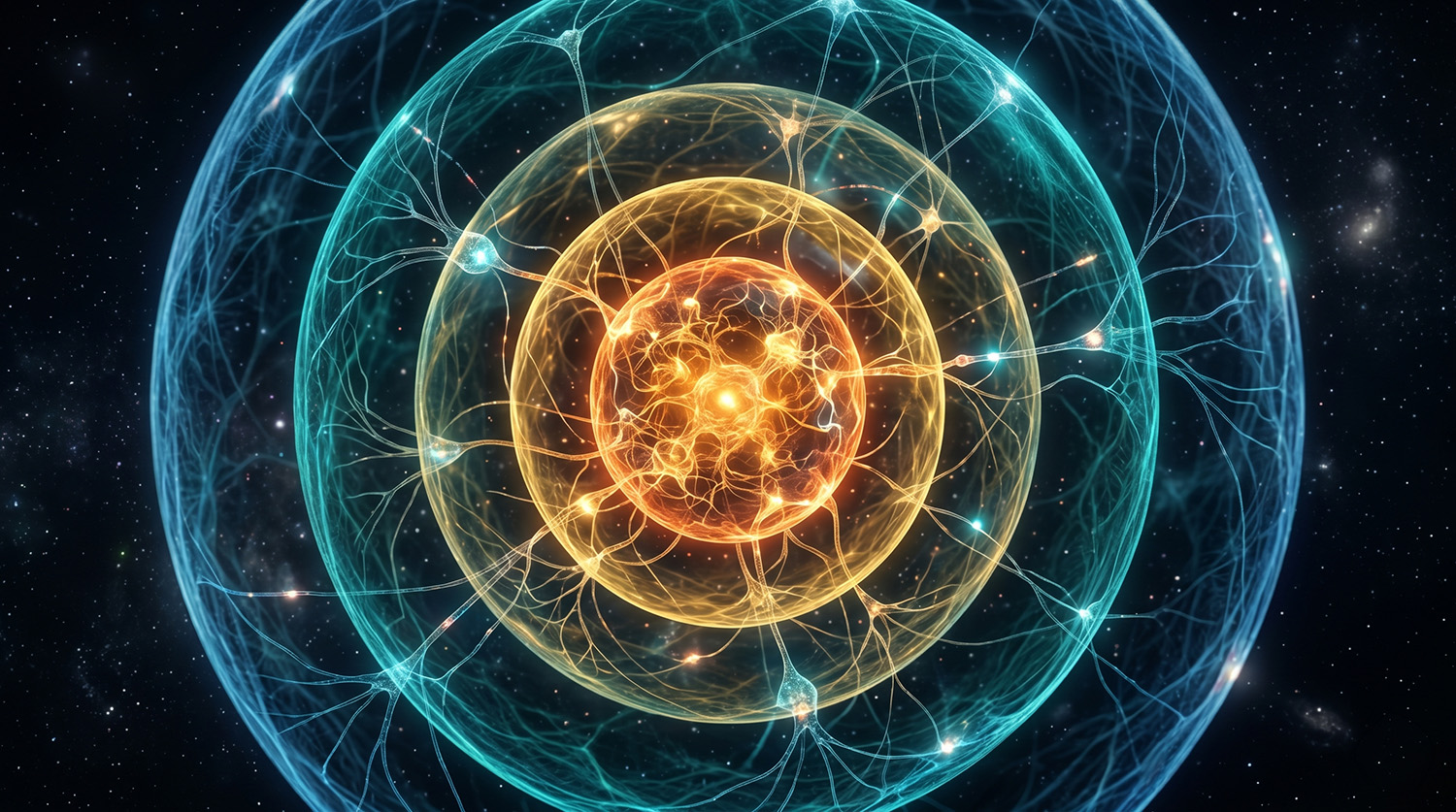
A schematic of operadic hierarchy in biological tissue: compartments nested within compartments, each computing at its own scale, with energy dissipation acting as the optimizer at every level. The same nested structure, the paper argues, is what adaptive AI systems are missing.
The framework also slots into a quietly maturing tradition in theoretical computer science that almost nobody outside the specialty has heard of. More than a decade ago, Susanne Still at the University of Hawaii, working with David Sivak, Anthony Bell and Gavin Crooks, proved that any system trying to be energetically efficient while modeling its environment must throw away non-predictive information. The cost of holding onto useless memory is real, measurable in joules. Jeremy England, then at MIT, framed the origin of life itself as dissipation-driven adaptation, with matter spontaneously rearranging into structures that better absorb and release energy. Menachem Stern, Andrea Liu and Sam Dillavou at the University of Pennsylvania built physical learning networks out of resistor lattices that train themselves through purely local rules, with no central processor, by letting the physics do the work.
There is, in other words, a growing body of evidence that learning is what energy dissipation looks like when it gets recorded into structure. The Tuyéras and Agudelo work is one of the first proposals to take this seriously and package it in compositional form. Karl Friston's free-energy principle has been pointing in a similar direction for decades, framing perception and action as variational inference under a hierarchical generative model. What Friston's framework has lacked is a concrete physical mechanism by which the hierarchy gets carved out of an undifferentiated medium. The new paper supplies one. Michael Levin's work on bioelectric morphogenesis at Tufts pushes from the other side, showing that cellular collectives compute target morphologies through electrical signaling that behaves like distributed pattern-matching. Place these next to the Daice Labs and MIT CSAIL paper and the outline of a research program comes into focus: take the rectification mechanism cells use, formalize it operadically, and use it as the inductive bias for adaptive computation.
The downstream implications reach further than AI. Software engineers have been groping toward similar ideas from a very different starting point. The microservices movement was a confession that monolithic codebases cannot evolve fast enough. Conway's Law, formulated in 1967, observes that any system you build will mirror the communication structure of the team that built it, a statement that is itself about compositional substrate. Nassim Taleb's notion of antifragility, that some systems gain from disorder rather than merely surviving it, has produced a small literature on chaos engineering and self-healing architectures. Netflix's Chaos Monkey, the tool that randomly kills servers in production to force the surviving system to specialize and harden, is in a sense a clumsy industrial version of asymmetric-drive rectification: introduce controlled disturbance, let the surviving structures specialize, lock in what works.
What the biology paper offers that the software engineering literature has not is precision. A formal mathematical account of what it means for a system to convert stress into structural memory, and a language (operads) for talking about how the resulting modules compose. This is not a metaphor. It is a specification. Scientists have already begun commercializing the ideas at Daice Labs, a Brookline-based company spun out of MIT CSAIL building hybrid AI systems that integrate specialized models, logic rules and bio-inspired design. They are not claiming that operadic compartments will replace transformers tomorrow. They are claiming that the dominant architecture is missing a layer, the layer at which specialization happens through stress rather than through gradient descent on a fixed graph, and that adding that layer changes what the system can do.
The argument that asymmetric-drive rectification is the missing substrate for adaptive AI is, for now, an argument from convergence. It rests on the observation that thermodynamic learning theorists, physical learning machine builders, neurosymbolic AI researchers, free-energy theorists, modular deep learning advocates and developmental biologists are all describing pieces of the same animal from different sides, and that this paper is one of the first to put a coherent mathematical body underneath the pieces. But the convergence is real. The current AI stack treats representation, reasoning, adaptation and memory as separate problems glued together by training tricks and inference-time scaffolding. Biology treats them as a single problem solved by a single mechanism: nested compartments under nonequilibrium drive, with stress as both the source of disturbance and the source of information about what to specialize.
If the next decade of AI looks different from the last, it will be because someone took seriously the idea that the substrate matters. Not the model class, not the training objective, but the underlying mathematical and physical character of the medium in which computation happens. The fat cells in your adipose tissue, going about their unglamorous business, may have been demonstrating the answer all along. They take the noise of metabolic life, rectify it through an asymmetric pump and a phase-aligned oscillation, and write the result into stable structural memory. They specialize without forgetting. They adapt without breaking. They do, in other words, what we have been trying and failing to teach machines to do.
The paper from Daice Labs and MIT CSAIL is one snapshot of one mechanism in one tissue, with a proof-of-concept algorithm attached. Whether or not the specific operadic formalism wins out, the structure of the argument is going to be hard to walk back. Adaptive intelligence, the kind that builds itself out of stress and stays built, is not coming from a bigger pile of attention heads. It is coming from a substrate that knows how to convert disturbance into structure. And that substrate, whenever we finish building it, is going to look a lot more like a cell than like a chip.
Primary source: Tuyeras, R. V., Morcuende, A., Llinares, C., Segerstolpe, A., Kellis, M., Femenia, T., Agudelo, L. Z. "Rectifying Stress into Structural Memory Drives Specialization in Cells and Adaptive Computational Systems." bioRxiv 2026. doi:10.64898/2026.01.29.702626v1
Related and adjacent work: Bengio et al., "Inductive Biases for Deep Learning of Higher-Level Cognition" (2021); Fong, Spivak and Tuyéras, "Backprop as Functor" (2019); Hasani et al., "Liquid Time-constant Networks," AAAI (2021); England, "Statistical physics of self-replication," Journal of Chemical Physics (2013); Still, Sivak, Bell and Crooks, "Thermodynamics of Prediction," Physical Review Letters (2012); Dillavou, Stern, Liu et al., "Demonstration of Decentralized Physics-Driven Learning," Physical Review Applied (2022); Friston, "The free-energy principle: a unified brain theory?" Nature Reviews Neuroscience (2010); Levin, "The Computational Boundary of a Self," Frontiers in Psychology (2019); Marcus, "The next decade in AI: four steps towards robust artificial intelligence" (2020); Trinh et al., AlphaGeometry, Nature (2024).
Daice Labs Inc.
Brookline, MA, USA
Roll the "daice"–exploration & programmable adaptation.

